


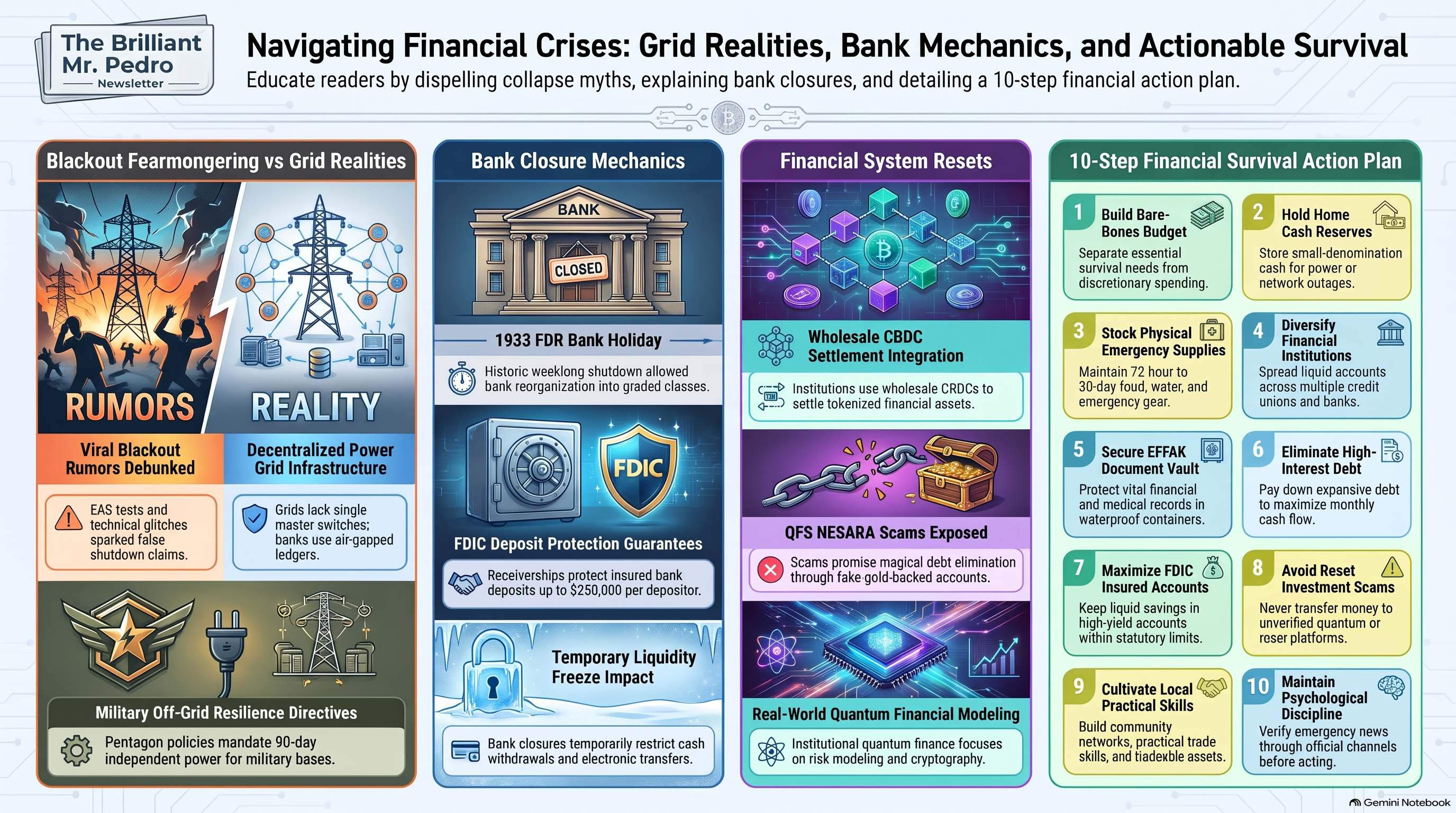
Your feed is full of blackout warnings, bank closure rumors, and “financial reset” promises. Some of it is exaggeration, some is outright scam, and a little contains a kernel of truth worth understanding. In this episode, I separate what’s real from what’s viral and give you a practical plan for protecting your family either way.
You can listen now.
What We Cover
Blackout panic, explained. The November rumors of an “imminent 90-day global blackout” came from three unrelated events: scheduled Federal Emergency Alert System (EAS) tests, an FAA telecommunications glitch, and a Microsoft outage. I walk through what each one was and why none of them signals a coming grid collapse.
Bill Gates: what he thinks and what he’s doing. To be clear, this segment is not a defense of Gates, and it isn’t an attack either. I’m simply laying out what he has said publicly and what he has invested in. Gates has warned about AI-enabled bioterrorism, and he is also one of the largest private owners of U.S. farmland, with investments in patented seed technology and synthetic foods. I separate what is documented from what is speculation, and I explain why people keep connecting the two. You can draw your own conclusions.
How bank closures actually work. From FDR’s 1933 National Bank Holiday to the Silicon Valley Bank run, I explain how FDIC receivership works, why insured deposits are protected up to $250,000 (per depositor, per bank, per ownership category), and why a temporary closure can still limit your access to physical cash.
The “financial reset” scams and claims. You’ve probably seen talk of NESARA/GESARA and a “Quantum Financial System” that will replace the banking system overnight. I took a close look at the claims. NESARA and GESARA have never been enacted by any government, and I couldn’t find any verifiable record that a QFS exists. What is real: banks and regulators are researching quantum computing for risk modeling and moving toward quantum-resistant encryption, and central bank digital currencies are a live policy debate. Some of the people sharing reset claims sincerely believe them, but scammers have used the same stories to sell “investments” and paid memberships. My advice is to treat any reset claim as unproven until it’s confirmed by an official source and never pay for early access to a “new system.”
The 10-step survival framework. A grounded roadmap covering emergency cash reserves, a document vault, and debt elimination, built to help you whatever the headlines do next.
What Is the EFFAK?
The survival checklist draws on a real, free resource called the Emergency Financial First Aid Kit (EFFAK). It was created by the nonprofit Operation HOPE in partnership with FEMA, and it has been around since 2004. It’s a guide and set of fill-in forms that help you gather your essential records in one place before an emergency, so you aren’t scrambling afterward.
It covers four categories:
Household identification: IDs, birth certificates, Social Security cards, passports, and pet records
Financial and legal documents: mortgage or lease, bank and retirement accounts, insurance policies, tax returns, wills, and powers of attorney
Medical information: insurance cards, medication lists, and doctor contacts
Household contacts: your lawyer, insurance agent, bank, landlord, and other key people
It also lists a few habits I’ll be talking about on the show: keep paper copies in a fireproof, waterproof box or safe, keep password-protected electronic copies on a flash or external drive, take photos or video of your home and valuables, and keep some cash with your kit in case ATMs aren’t working or banks are closed. It also advises against writing down your actual passwords and PINs.
You can get the full guide free at ready.gov/financialpreparedness or operationhope.org, or by calling FEMA at (800) 480-2520 and asking for publication P-1075. The EFFAK is a government-backed preparedness tool for everyday emergencies like fires, floods, and job loss. It’s not tied to any blackout rumor, which is exactly why it’s useful.
Where I’m Coming From
Every episode of this show is built on three principles:
Pro-growth and pro-American energy. Reliable, domestically produced energy makes for a more resilient country than a fragile, centralized grid.
Free-market independence. I favor private enterprise, sound money, and personal financial self-reliance, and I’m skeptical of overreaching regulation and centralized digital-currency tracking.
Calm over panic. Facts, historical context, and clear action steps beat sensationalism every time.
Listen to the episode, grab your checklist, and tell me what you think in the comments. Which rumor have you seen the most?
Here’s the Financial Collapse Survival Checklist you need to download:

#BankClosures #FDIC #BlackoutRumors #EmergencyFund #FinancialSurvival #EFFAK


